
Exterior Soffit Pot Lights in Oakville: Brightness, Placement & Neighbouring Properties
Plan exterior soffit lighting around useful coverage, shielded direction, property relationships, controls and after-dark adjustment.
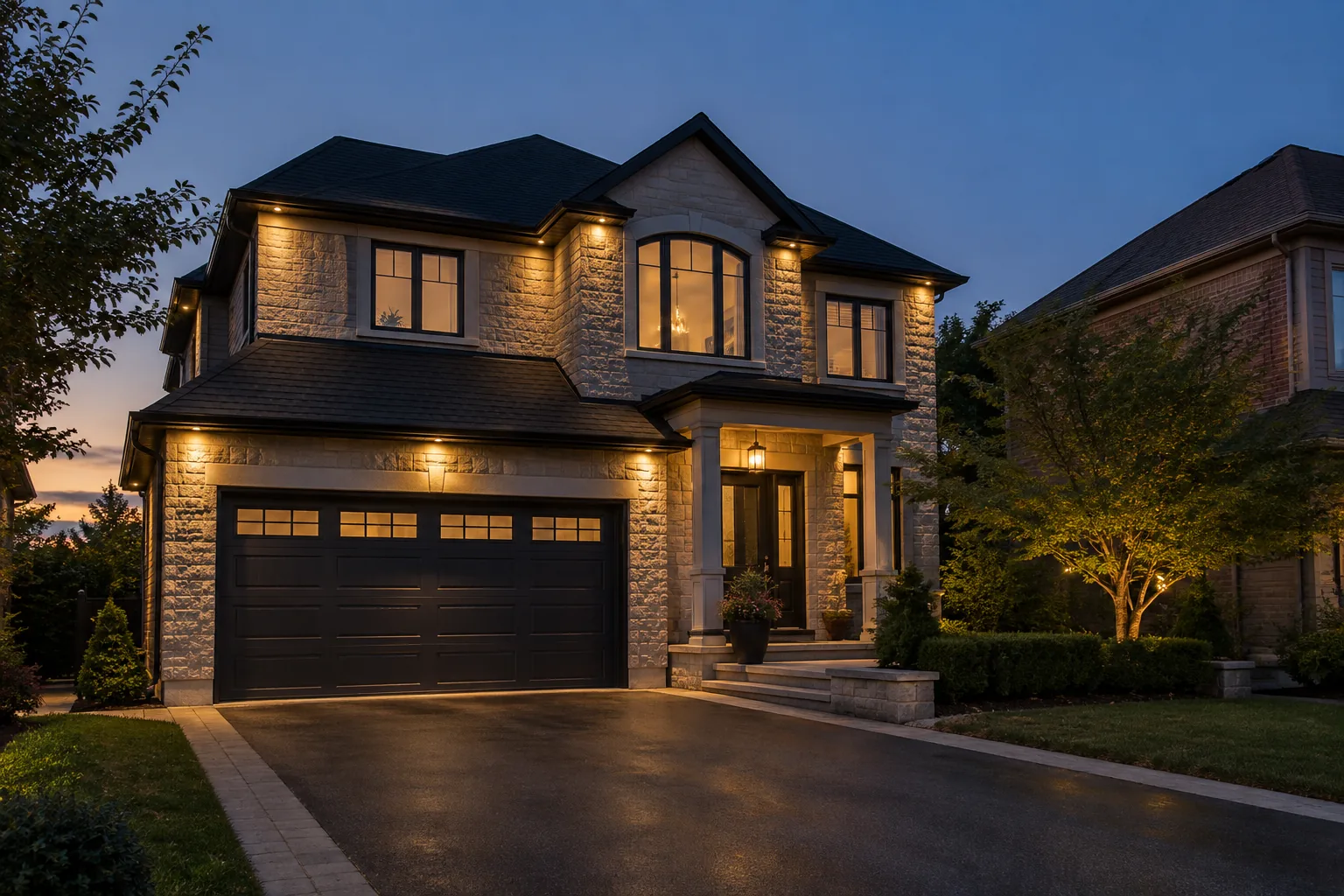
Exterior lighting should make entries, paths and selected architectural features easier to see without turning every soffit bay into a bright source. Purpose, aiming and control matter more than fixture count.
Assign a purpose to every exterior light
Exterior lighting can support entry recognition, path visibility, steps, garage circulation, patio use, cameras or selected architecture. Those purposes need different positions and output. A bright row across an entire elevation may create more glare than useful ground light, especially when the sources are visible from the street or neighbouring windows.
Begin with a dusk walk around the property. Mark doors, steps, changes in grade, gates and destinations. Note existing streetlight, porch and landscape contributions. Add light only where it improves a defined task or composition. Darkness between lit areas provides contrast and helps the important locations read clearly.
- Entries and address visibility
- Steps, gates and grade changes
- Garage and driveway circulation
- Patio tasks and seating
- Camera-support zones
- Selected wall or landscape features
Soffit height and setback change the beam
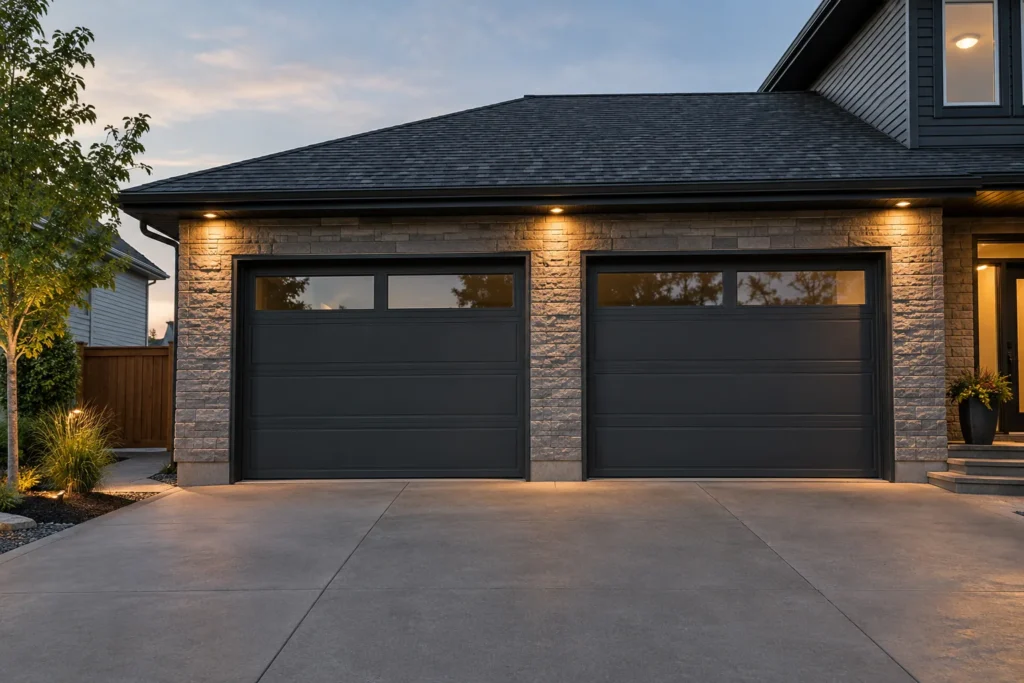
A fixture mounted high under a soffit can spread broadly by the time it reaches the wall or ground. If it sits close to the wall, a narrow beam may produce a bright vertical streak. If it sits near the fascia, the source can be more visible from across the street. The roof line, eavestrough, windows and cladding all affect the appropriate setback.
Beam data should guide placement. Fixed downlights suit general downward coverage; adjustable products can emphasize a controlled target when their aiming remains within the property. More fixtures are not always needed to create continuity. Wider beams at modest output can connect an entry and garage more comfortably than many high-output apertures.
- Measure mounting height.
- Record soffit depth and roof details.
- Review beam angle and delivered lumens.
- Check source visibility from the street.
- Keep adjustable beams on intended surfaces.
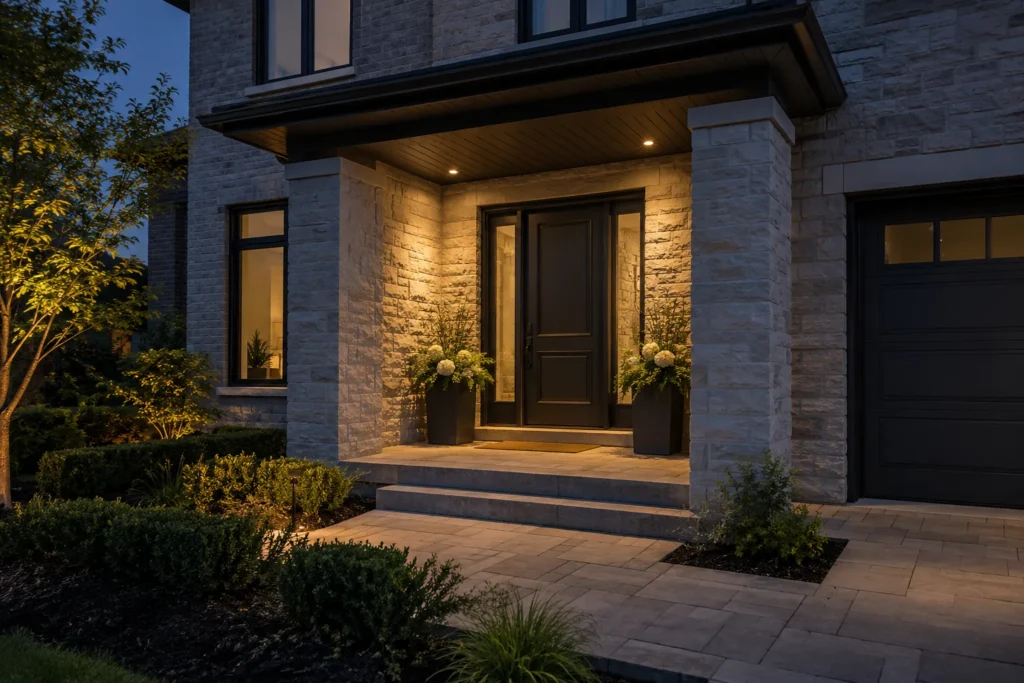
Brightness should be judged from several viewpoints
Standing directly below a fixture does not reveal how it affects a bedroom window next door or a driver approaching the house. Review the proposed locations from property edges, neighbouring sightlines and the public approach. Glossy cladding, snow and pale paving can increase reflected brightness. Mature foliage can later redirect or block the same beam.
Use the lowest output that meets the purpose, then add shielding or revise aiming before adding more intensity. Where dimming is supported by a suitable exterior system, it can help seasonal adjustment. Dimming does not correct a source that points toward another property or remains visually harsh from common viewpoints.
- Review from neighbouring-window direction.
- Check the property line and sidewalk.
- Consider snow and wet-paving reflection.
- Use shielding before excess output.
- Reassess after landscaping changes.
Oakville nuisance language is outcome-based
The municipal nuisance language reviewed for this site addresses an unusual quantity or type of light shining on the land of others so that it causes a nuisance. It should not be rewritten as a made-up universal lumen limit or a fixed number of permitted soffit lights. Current Town information and the actual property relationship control a property-specific question.
A restrained plan supports that practical outcome: direct light downward, keep output proportionate, limit operating hours and correct spill after dark. Condominium, heritage, landlord or development rules may add separate requirements. Those approvals should be identified before fixtures are purchased or openings are made.
- Do not rely on an invented numeric threshold.
- Keep beams within the intended area.
- Check current Town information.
- Review condominium or heritage requirements.
- Respond to observed spill after dark.
Choose products for exposure and service
Exterior recessed fixtures need the location rating required by their exposure. Damp and wet conditions are not interchangeable, and the soffit assembly does not automatically protect a product from wind-driven moisture. Temperature range, gasket details, corrosion resistance, driver access and compatible cable methods also matter.
Selectable colour temperature is useful only when every fixture is set consistently and the final choice is recorded. Warmer exterior light often feels comfortable on brick, stone and landscaping, while a cooler setting may appear more conspicuous at the same measured output. Colour rendering matters at entries and around planting, but output and aiming still govern spill.
- Confirm damp or wet-location suitability.
- Check operating-temperature limits.
- Review trim and fastener durability.
- Plan accessible drivers and junctions.
- Record colour-temperature settings.
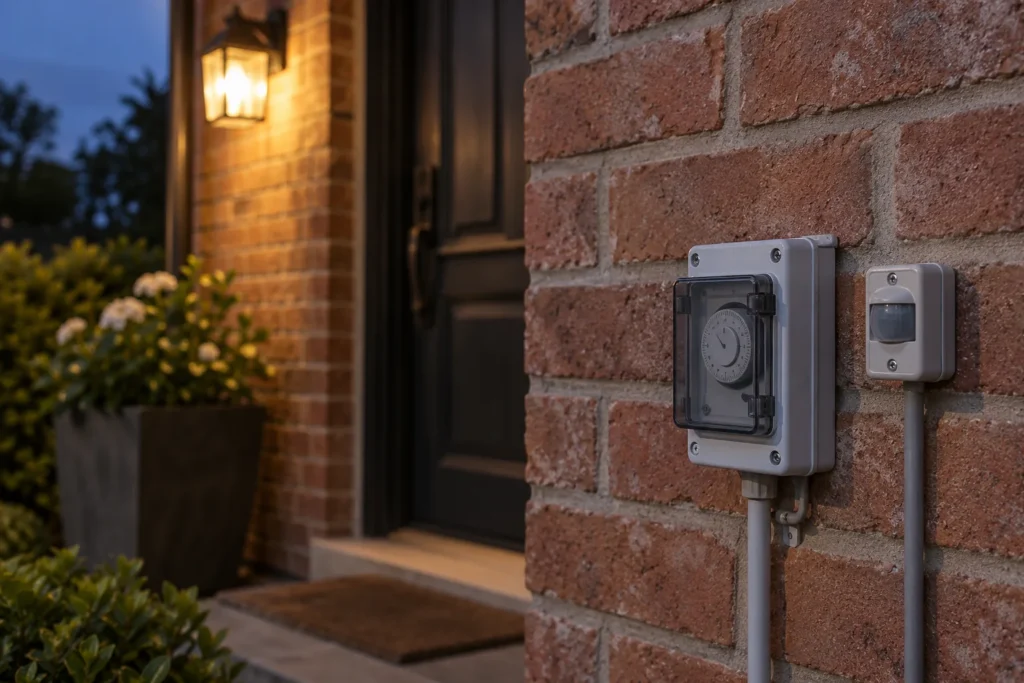
Controls prevent unnecessary operation
Photocells can respond to ambient light, astronomical timers can follow sunset schedules and motion sensors can activate selected zones. Each has a different purpose. A photocell alone may keep decorative lights on all night. A motion sensor may trigger repeatedly from traffic, branches or animals if the detection field is too broad. A timer needs seasonal and power-loss review.
Combine controls carefully rather than stacking devices without compatibility data. Essential entry lighting may run at modest output during occupied evening hours, while side-yard or rear security zones respond to motion. Manual override should remain understandable, and connected controls should not make ordinary exterior operation dependent on a phone.
- Set an evening schedule.
- Aim motion detection inside the property.
- Separate entry and security functions.
- Keep manual override clear.
- Review settings seasonally.
Coordinate cameras without chasing extreme brightness
Security cameras often perform better with even, controlled illumination than with one bright hotspot beside deep darkness. A fixture close to the lens can create flare, illuminate insects or reflect from a soffit. Infrared operation and visible lighting can interact differently between camera models. Place and test both systems together after dark.
Lighting should support identification at the relevant path or doorway rather than flooding the complete lot. Motion timing needs enough duration for safe movement and camera capture without remaining active unnecessarily. Final aiming may require a return visit once the homeowner has observed actual night conditions.
- Avoid a bright source beside the lens.
- Light approach paths evenly.
- Check infrared and visible-light interaction.
- Set practical motion duration.
- Review recorded night footage.
Finished soffits still contain obstacles
Soffit cavities can contain framing, ventilation paths, insulation, wiring and architectural details. Decorative panel spacing may suggest one fixture rhythm that conflicts with concealed conditions. Existing exterior cable does not prove capacity or routing for a full new row. Product openings must preserve the soffit system and required clearances.
The quote should distinguish direct replacement from new locations. It should also identify access equipment, circuit and control changes, weather sealing, fixture ratings, finish repair, notification handling and after-dark aiming. If high roof lines or sloped ground require specialty access, that condition belongs in the scope.
- Inspect the soffit assembly.
- Protect ventilation functions.
- Verify existing wiring rather than assuming.
- Include access equipment.
- Define finish and weather-sealing responsibility.
Commission the lighting after dark
Daylight installation can confirm alignment and operation, but it cannot prove night-time comfort. After dark, view every zone from the entry, driveway, property edge and neighbouring directions. Adjust gimbals, sensor fields, timers and dimming. Look for glare on windows, cameras and wet pavement as well as direct spill.
Keep a simple record of fixture model, colour setting, control schedule, sensor sensitivity and aiming. Review it after the first snow, leaf growth or exterior renovation. A well-commissioned system is easier to maintain because later changes can be compared with a known starting point.
- Walk the full perimeter after dark.
- Adjust beam and sensor direction.
- Confirm timer and photocell transitions.
- Check neighbouring viewpoints.
- Record final settings.
Turn the article into a short site-review checklist
Before requesting a price, write down the decisions this article helped you make and the conditions that still require verification. Include dimensions, ceiling height, intended light targets, existing fixtures and controls, access above or beside the area, and product preferences. Wide photographs should show the full ceiling or exterior elevation and normal viewing positions. Do not remove electrical covers or enter unsafe ladder, attic or roof areas to collect information.
Ask the final scope to identify products, fixture quantity, control devices, routing assumptions, protection, cleanup, electrical notification and excluded finish work. Keep the accepted scope, later changes, product documentation, final layout and Certificate of Acceptance for notified work together. Those records give future service work an accurate starting point.
Questions about this topic
How many soffit lights should an Oakville house have?
There is no responsible town-wide count. Elevation length, mounting height, beam spread, purpose and neighbouring sightlines determine the useful quantity.
Is there one Oakville brightness limit for residential soffit lights?
The nuisance language reviewed for this site is outcome-based rather than a universal fixture or lumen count. Check current Town information for a property-specific concern.
What colour temperature works outdoors?
Warm or warm-neutral light often supports residential materials and visual comfort, but coordinate it with existing entry and landscape lighting and judge it after dark.
Should soffit lights remain on all night?
Not automatically. Use schedules, photocells or motion control matched to the purpose and keep manual operation clear.
When should aiming be finalized?
Confirm basic operation in daylight, then commission brightness, aiming and controls after dark from several viewpoints.
Related Oakville lighting resources
Turn the planning notes into a property-specific scope.
Share the room or exterior area, dimensions, ceiling height, existing lighting, preferred fixtures and safe-to-take photographs. Concealed conditions and current requirements still need to be verified for the actual work.